
- news
- Call for Papers Special Issue: Beyond Numbers and Narratives: Gender Quotas, Power, and Women’s Political Voice in Pakistan
Call for Papers Special Issue: Beyond Numbers and Narratives: Gender Quotas, Power, and Women’s Political Voice in Pakistan
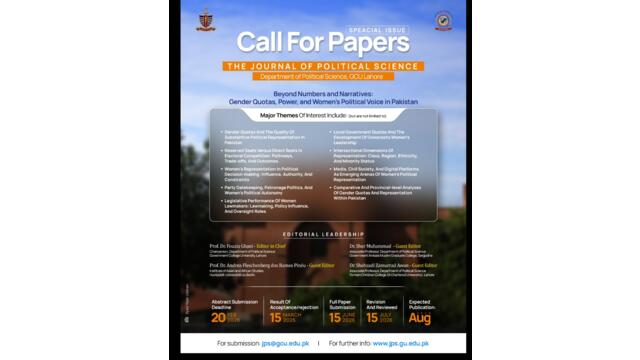
Call for Papers Special Issue: Beyond Numbers and Narratives: Gender Quotas, Power, and Women’s Political Voice in Pakistan
Editor-in-Chief
Prof. Dr. Fouzia Ghani, Chairperson, Department of Political Science, Government College University, Lahore
Guest Editors
1. Prof. Dr. Andrea Fleschenberg dos Ramos Pinéu
Institute of Asian and African Studies
Humboldt-Universität zu Berlin
2. Dr. Sher Muhammad
Associate Professor, Department of Political Science, Government Ambala Muslim Graduate College, Sargodha
3. Dr. Shehzadi Zamurrad Awan
Associate Professor, Department of Political Science, Forman Christian College (A Chartered University), Lahore
Gender quotas are considered a crucial policy measure to enhance women's representation in politics. The primary objective is to increase the visibility of women in politics, particularly in countries where female presence in legislative assemblies remains low due to entrenched patriarchal norms and socio-cultural barriers. The move may remove the inherent sense of marginalization among them. It is, however, a temporary measure until women can contest elections for general seats. Although highly controversial, electoral gender quotas are today being introduced in an increasing number of countries around the world. As a successor state to British India, women in Pakistan inherited the right to vote and contest elections, rights that had already existed before independence in 1947. Although all three constitutions of Pakistan contained provisions for reserved seats for women, their representation at both the legislative and party levels has remained very low. The lapse of reserved seats in the National Assembly in 1988 further exacerbated this marginalization. As a result, in the general elections of 1997, women’s representation declined to a critically low level of 0.4 percent in the Provincial Assemblies, 2 percent in the Senate, and only 4 percent in the National Assembly. A significant shift occurred with the introduction of the Devolution of Power Plan 2000, which aimed to empower women at the grassroots level by reserving 33 percent of seats in local governments. This momentum was reinforced by the Legal Framework Order (LFO) of 2002, which reserved 17 percent of seats for women in the National Assembly, the Senate, and the four provincial assemblies. Subsequently, Section 206 of the Elections Act, 2017, mandated that political parties allocate at least five percent of their general seat tickets to women candidates. Taken together, these institutional reforms have significantly expanded women’s descriptive representation across national, provincial, and local tiers of governance, though their transformative impact on substantive representation and political empowerment remains subject to debate.
Existing scholarship in Pakistan has predominantly focused on numerical inclusion. This special issue critically interrogates descriptive representation by assessing the quality, efficacy, and transformative impact of women’s political engagement through these policy initiatives. The Journal of Political Science, Department of Political Science, Government College University Lahore, invites original research articles for a forthcoming special issue focusing on gender quotas and women’s political representation in Pakistan. The special issue aims to bring together theoretically informed and empirically grounded contributions that explore how gender quotas interact with party structures, informal institutions, dynastic politics, and socio-cultural constraints to shape women’s political agency across national, provincial, and local levels.
Major themes of interest include (but are not limited to):
1. Gender quotas and the quality of substantive political representation in Pakistan
2. Reserved seats versus direct seats in electoral competition: pathways, trade-offs, and outcomes
3. Women’s representation in political decision-making: influence, authority, and constraints
4. Party gatekeeping, patronage politics, and women’s political autonomy
5. Legislative performance of women lawmakers: lawmaking, policy influence, and oversight roles
6. Local government quotas and the development of grassroots women's leadership
7. Intersectional dimensions of representation: class, region, ethnicity, and minority status
8. Media, civil society, and digital platforms as emerging arenas of women’s political representation
9. Comparative and provincial-level analyses of gender quotas and representation within Pakistan
Methodological Scope:
The journal welcomes qualitative, quantitative, and mixed-methods research, including elite interviews, legislative behavior analyses, surveys, comparative case studies, and institutional or discourse-based approaches. Interdisciplinary perspectives from political science, gender studies, sociology, and public policy are encouraged.
Submission Guidelines:
Manuscripts must be original and not under consideration elsewhere. Submissions should follow the Journal of Political Science author guidelines. All papers will undergo a double-blind peer review process.
Important Dates:
Abstract submission deadline: 20 February 2026
Result of Acceptance/Rejection: 15 March 2026
Full paper submission deadline: 15 June 2026
Revision and Review: 15 July 2026
Expected publication: August 2026
For Submission: jps@gcu.edu.pk
We strongly encourage scholars, researchers, and practitioners working on gender, politics, and governance in Pakistan and abroad to contribute.